


Best overall for outdoor fitness: a GPS running smartwatch. Best for workouts and phone features: a phone-connected smartwatch. Best for basic activity goals: a basic activity smartwatch. This 2026 guide ranks watch types by how you exercise, so you can choose useful tracking features without mistaking a long specification list for a better fit.
- The best smart watches for fitness tracking match your workouts, phone compatibility, and charging habits.
- Choose a GPS running smartwatch when recording outdoor routes without your phone matters most.
- Choose a multisport smartwatch for workouts that combine swimming, cycling, and running.
- Use Pendazi to compare smart watches, then verify each listing’s exact model and fitness features.
Why this matters
A smartwatch records activity; it does not decide which activity matters to you. A runner needs different information from someone who wants walking reminders, and neither benefits from features they never use.
Pendazi is a multi-vendor marketplace that sells smart watches alongside other product categories. Compare the exact model described in each listing rather than assuming every watch has the same sensors, phone support, or workout modes.
For fitness tracking in 2026, choose the watch around your hardest compatibility requirement—not the longest feature list. Start with your phone, your main workout, and whether you carry your phone while exercising.
What makes the best fitness smartwatch?
Use these criteria before comparing designs. A watch that fails a requirement you depend on is the wrong choice, regardless of its other features.
- Phone compatibility: Confirm support for your phone’s operating system and the companion app. Separate basic pairing from features that require a particular phone.
- Workout relevance: Check that the watch records your actual activity. An activity label alone does not establish which measurements the watch captures.
- Location tracking: Distinguish built-in GPS from connected GPS, which uses your phone’s location. This matters when you leave your phone behind.
- Wearability: Assess case size, strap adjustment, and comfort during movement. A watch you remove frequently leaves gaps in your activity record.
- Charging fit: Check stated battery conditions, especially whether they include GPS workouts or an always-on display. Different operating modes are not directly comparable.
- Data access: Confirm which records you can review, export, or share. Check whether any features you need require a separate subscription.
Fitness smartwatches at a glance
These are buying categories, not claims that every model within a category has identical features. The ranking gives each option a distinct job; verify the specific watch before choosing it.
| Rank and watch type | Best for | Standout feature to verify | Key limitation |
|---|---|---|---|
| 1. GPS running smartwatch | Outdoor running without a phone | Built-in GPS and run-specific workout records | GPS use changes charging requirements |
| 2. Phone-connected smartwatch | Everyday workouts and phone integration | Compatibility with the phone functions you use | Features can depend on the paired phone |
| 3. Basic activity smartwatch | Walking and daily movement goals | Clear activity summaries and reminders | Limited training detail on simpler models |
| 4. Multisport smartwatch | Combined swim, bike, and run sessions | Multisport recording and activity transitions | More setup than basic activity tracking |
| 5. Compact fitness smartwatch | Smaller wrists and overnight wear | Suitable dimensions and adjustable fit | Smaller displays leave less room for workout data |
1. GPS running smartwatch: best for phone-free outdoor runs
A GPS running smartwatch is the default choice when outdoor routes are central to your training. Choose a model with built-in GPS if you want to record location without carrying your phone; connected GPS does not meet that requirement.
The useful distinction is not how many sports appear in the menu. It is whether you can start a run, read the information you need, and review the session afterward without unnecessary steps.
GPS running smartwatch pros:
- Built-in GPS supports route recording without a paired phone supplying location.
- Run-specific screens can put relevant workout information together.
- Physical controls, when included, provide an alternative to touchscreen operation.
GPS running smartwatch cons:
- Active GPS adds power demand, so everyday battery claims do not describe continuous workout use.
- Run-focused features add little value if your exercise is mainly indoor walking or casual activity.
- Satellite reception and surroundings affect location tracking; a recorded route is not a perfect measurement.
Before buying in 2026, check the GPS operating mode, workout controls, and which running measurements the exact model records. Do not treat an outdoor-running icon as proof of built-in GPS.
Best for: Runners who want outdoor route records without taking their phone.
Verdict: Buy a GPS running smartwatch if independent outdoor tracking is your main requirement.
2. Phone-connected smartwatch: best for workouts and phone features
A phone-connected smartwatch combines activity tracking with functions linked to your phone. Depending on the model and pairing, those functions include notifications, calls, apps, or media controls.
Start with compatibility rather than appearance. A watch that pairs successfully does not necessarily support every advertised function on every phone.
Phone-connected smartwatch pros:
- Combines workout records and everyday phone interactions on your wrist.
- A companion app gives you another place to review activity.
- Supported apps can extend the watch beyond its built-in workout tools.
Phone-connected smartwatch cons:
- Some functions depend on the phone model, operating system, or connection.
- Notifications compete with workout information unless you adjust settings.
- App support and fitness functions differ between models, even when the watches look similar.
For a 2026 purchase, write down the phone functions you actually need. Then check them individually: receiving an alert, reading its content, and replying to it are different capabilities.
Best for: People who want one watch for routine exercise and everyday phone interactions.
Verdict: Buy a phone-connected smartwatch when phone integration matters as much as fitness tracking.
3. Basic activity smartwatch: best for daily movement goals
A basic activity smartwatch suits someone who wants a clear record of walking and everyday movement rather than detailed training analysis. Prioritize an understandable activity summary, comfortable fit, and controls you will use consistently.
Do not assume that a simpler watch is automatically easier to use. Check the companion app, permission requirements, and how you reach your daily activity record.
Basic activity smartwatch pros:
- Keeps attention on everyday movement rather than specialist training measurements.
- Simple summaries make routine activity easier to review.
- Reminders, when included, provide prompts without requiring a planned workout.
Basic activity smartwatch cons:
- Step counts do not describe the full effort of cycling, strength training, or other non-walking exercise.
- Simpler models offer less detail for reviewing structured training.
- Connected GPS still requires a phone if you want location records.
Use activity targets as prompts, not medical instructions. The U.S. Department of Health and Human Services recommends at least 150 minutes per week of moderate-intensity aerobic activity, or 75 minutes per week of vigorous-intensity activity, plus muscle-strengthening activity on 2 days per week for adults. A step total alone does not show whether you meet those different recommendations.
Best for: Walkers and beginners who want everyday activity awareness.
Verdict: Buy a basic activity smartwatch if daily consistency matters more than detailed workout analysis.
4. Multisport smartwatch: best for combined swim-bike-run training
A multisport smartwatch is the specialist option for sessions that combine different activities. Verify that the model supports recording transitions within a session rather than merely offering separate swimming, cycling, and running modes.
Swimming requires particular care. Check the manufacturer’s stated swimming use and restrictions; a water-resistance description alone is not permission for every water activity.
Multisport smartwatch pros:
- Supported multisport recording keeps combined activities within a coordinated workout record.
- Activity-specific screens let you review different information for different disciplines.
- Supported external sensors expand the measurements available during training.
Multisport smartwatch cons:
- Additional modes require setup and practice before an important session.
- Sensor support must be checked by device and connection standard.
- Specialist functions are unnecessary if you never combine activities.
For 2026 comparisons, separate three questions: does the watch record each sport, does it record transitions, and does it connect to your existing equipment? A yes to the first question does not answer the others.
Best for: Athletes whose workouts combine swimming, cycling, and running.
Verdict: Buy a multisport smartwatch for combined sessions; skip it if separate basic workouts cover your needs.
5. Compact fitness smartwatch: best for smaller wrists
A compact fitness smartwatch puts fit ahead of a large display. Check the manufacturer’s case dimensions and supported wrist measurements rather than relying on a photograph or a description such as small.
This category overlaps with running and phone-connected watches. Its distinct purpose is solving a fit problem: the right functions do not help if the watch shifts around or feels uncomfortable during use.
Compact fitness smartwatch pros:
- A suitably sized case reduces overhang on a smaller wrist.
- An adjustable strap helps maintain stable contact during movement.
- A comfortable fit makes extended and overnight wear more practical.
Compact fitness smartwatch cons:
- A smaller screen leaves less space for simultaneous workout information.
- Touch targets and text require closer inspection before choosing.
- A compact case does not automatically mean a suitable strap or comfortable fit.
If sleep tracking matters, assess comfort as carefully as the sleep feature list. A device that interrupts your sleep is a poor trade for another overnight chart.
Best for: Smaller-wristed shoppers who prioritize comfortable daily and overnight wear.
Verdict: Buy a compact fitness smartwatch when fit is the obstacle to consistent use.
How to check a smartwatch listing before choosing
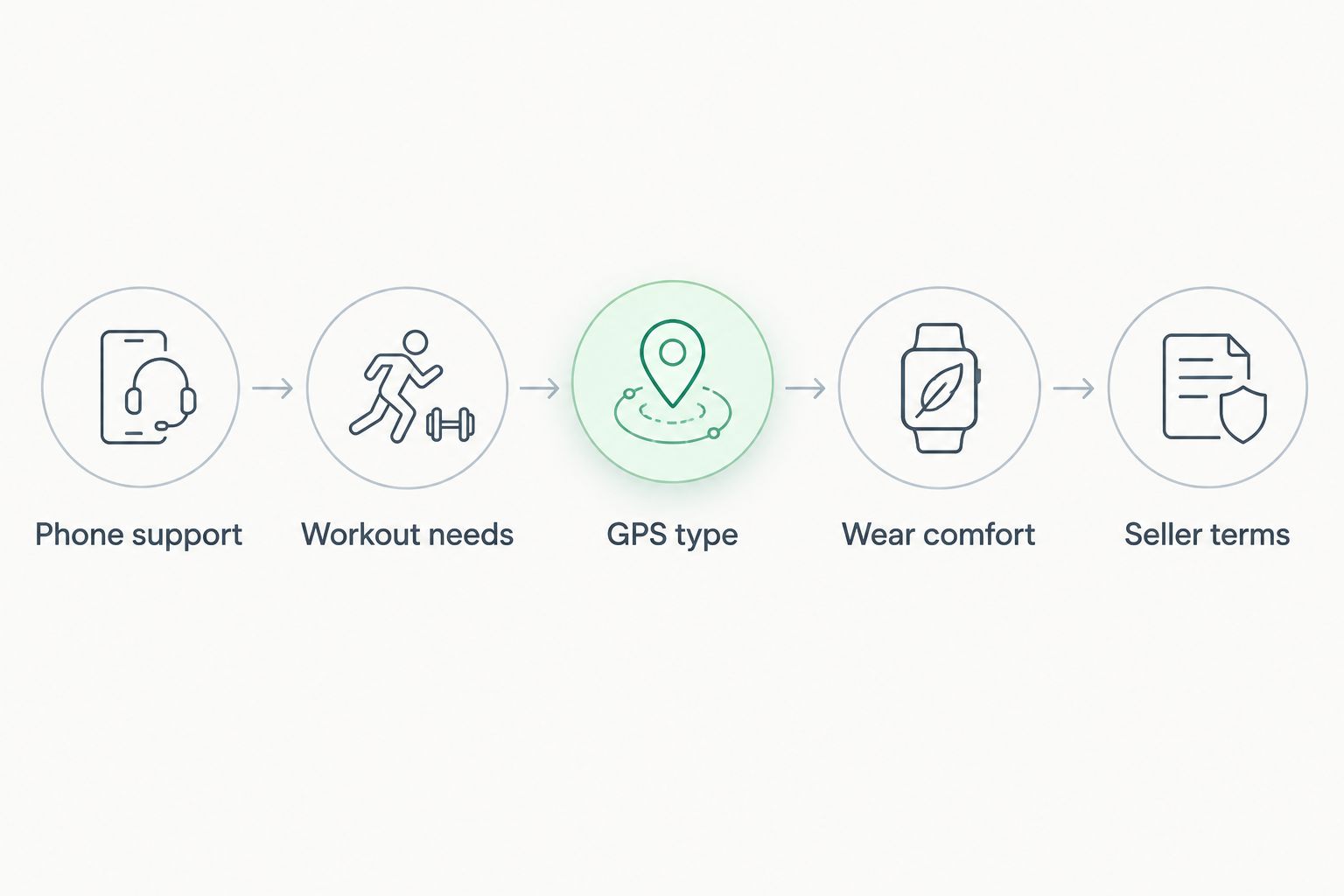
Use this sequence when comparing Pendazi smart watches or any other marketplace listings. Keep the exact model name beside your notes so that similar-looking versions do not become interchangeable.
- Phone support: Confirm the operating system, companion app, and features supported by your phone.
- Workout needs: Match the watch’s documented recording functions to your main exercise.
- GPS type: Establish whether location recording is built in or supplied by your phone.
- Wear comfort: Check case dimensions, strap adjustment, and the controls you will use while moving.
- Seller terms: Read the listing’s seller information and applicable return terms before committing.
The listing and the manufacturer’s documentation should describe the same model. If they conflict on a requirement you need, resolve the discrepancy before choosing—not after setup.
How we ranked these watch types
The ranking prioritizes workout relevance, independent location tracking, phone compatibility, comfort, charging fit, and access to records. It compares buying categories rather than presenting an unverified model-by-model performance test.
The GPS running smartwatch takes the default outdoor-fitness slot because its defining requirement is clear: recording routes without a phone. The other categories win when phone integration, simple activity tracking, combined sports, or wrist fit matters more.
Which fitness smartwatch should you choose?
Choose a GPS running smartwatch if outdoor exercise is your main reason for buying. Choose a phone-connected smartwatch if you want fitness records alongside everyday phone functions, or a basic activity smartwatch if your goal is simply moving more consistently.
For your 2026 shortlist, eliminate watches that fail a must-have requirement before comparing extras. When comparing fitness smartwatches on Pendazi, keep the exact model and seller terms attached to each option; the marketplace name does not establish an individual watch’s capabilities.
FAQ
What are the best smart watches for fitness tracking in 2026?
The best smart watches for fitness tracking match your main workout and phone. Choose a GPS running smartwatch for phone-free outdoor routes, a phone-connected smartwatch for everyday integration, or a basic activity smartwatch for daily movement goals.
Do I need built-in GPS for fitness tracking?
You need built-in GPS if you want outdoor location recording without your phone. Connected GPS uses your phone’s location, while basic activity tracking does not necessarily require location recording.
Is a smartwatch step count enough to measure my fitness?
No, a step count does not measure every form of exercise or your overall fitness. Cycling, strength training, and other activities require different records, so choose tracking that matches what you do.
Can I swim with any water-resistant smartwatch?
No, water resistance alone does not establish suitability for every swimming activity. Follow the exact model’s manufacturer instructions, including restrictions on water activities and operating conditions.
Will every smartwatch work with my phone?
No, smartwatch compatibility depends on the model, phone operating system, and companion app. Check individual functions as well as basic pairing before choosing.
Is a smaller smartwatch better for sleep tracking?
A smaller smartwatch is better for overnight wear only if it fits comfortably. Check the case dimensions and strap adjustment rather than assuming a smaller screen guarantees a better fit.
What should I check when comparing smart watches on Pendazi?
Check the exact watch model, phone compatibility, GPS type, workout functions, and seller terms. Pendazi is a multi-vendor marketplace, so assess each listing rather than treating all watches as equivalent.
One last thing
Before your first important workout, practice starting, pausing, and ending an ordinary session. Check the saved record afterward. A watch that records the wrong activity correctly is still giving you the wrong record—and learning the controls matters more than adding another unused feature.
Discover more from Pendazi
Subscribe to get the latest posts sent to your email.





Leave a Reply