


Best overall format: a lap-size weighted plush for seated comfort. Best for travel: a compact weighted plush. Best for cleaning: a plush with a removable weighted insert. This 2026 guide compares weighted stuffed animals for anxiety by how you use, carry, and care for them—not by unsupported promises of symptom relief.
- For weighted stuffed animals for anxiety, choose a lap-size format for seated comfort, not a promised treatment effect.
- Compact weighted plush suits carrying; removable-insert designs suit shoppers who prioritize cleaning.
- Pendazi is a general marketplace; evaluate each seller’s product details before choosing a weighted plush.
- Skip any design you cannot move independently or whose care instructions are unclear.
Why this matters
A weighted stuffed animal combines a soft toy with added mass. You can hold it, rest it across your lap, or include it in a quiet routine. Whether that sensation feels comforting is personal; heavier does not automatically mean more helpful.
A weighted stuffed animal is a comfort object, not a substitute for anxiety treatment. Evidence about weighted blankets does not establish that a particular stuffed animal treats anxiety. Product descriptions should not blur that distinction.
Pendazi is a multi-vendor marketplace selling toys alongside other product categories. Use its individual listings to check construction, intended use, and seller information rather than treating the marketplace name as a product specification.
The best purchase is the one you can use comfortably and maintain correctly. A plush that feels awkward, cannot be cleaned as needed, or interferes with movement is the wrong choice regardless of its appearance.
What makes the best weighted stuffed animals for anxiety?
Use these criteria when comparing weighted plush in 2026. They prioritize practical fit over claims that a particular animal shape or filling will calm everyone.
- Comfortable placement: The plush should sit where you intend to use it without pressing on your throat, covering your face, or forcing an awkward posture.
- Independent removal: You should be able to lift, reposition, and remove it without assistance. Do not choose a heavier design simply because it sounds more effective.
- Clear construction: Look for an explicit description of the outer fabric, weighted filling, and whether the insert comes out. Photos alone cannot confirm these details.
- Usable care instructions: Confirm which components can be washed and how they must dry. A washable cover does not mean the weighted insert is washable.
- Appropriate intended use: Check age guidance, warnings, and whether the product is intended for holding, lap placement, or another position.
- Tolerable sensory details: Texture, seams, scent, and sound matter. A comforting appearance does not compensate for fabric you dislike touching.
Weighted plush formats at a glance
These are ranked buying formats, not named products or a claim of hands-on testing. The 2026 comparison separates the main reasons to choose each design; an individual product can combine several features.
| Rank and format | Best for | Standout feature to verify | Key limitation |
|---|---|---|---|
| 1. Lap-size weighted plush | Seated comfort at home | Shape that rests securely across your lap | Less convenient to carry between locations |
| 2. Compact weighted plush | Travel and commuting | Dimensions and total weight that fit your carrying routine | Smaller size does not guarantee a lighter load |
| 3. Removable-insert plush | Cleaning and shared handling | Separate care instructions for shell and insert | More components to remove and reassemble |
| 4. Long-body weighted plush | An arm-around hugging position | Length and filling distribution that suit your posture | Awkward fit in compact seating or bags |
Choose the use case before the animal design. If you need something for a commute, carrying burden matters more than a large hugging surface; if cleaning is the priority, the construction matters more than the silhouette.
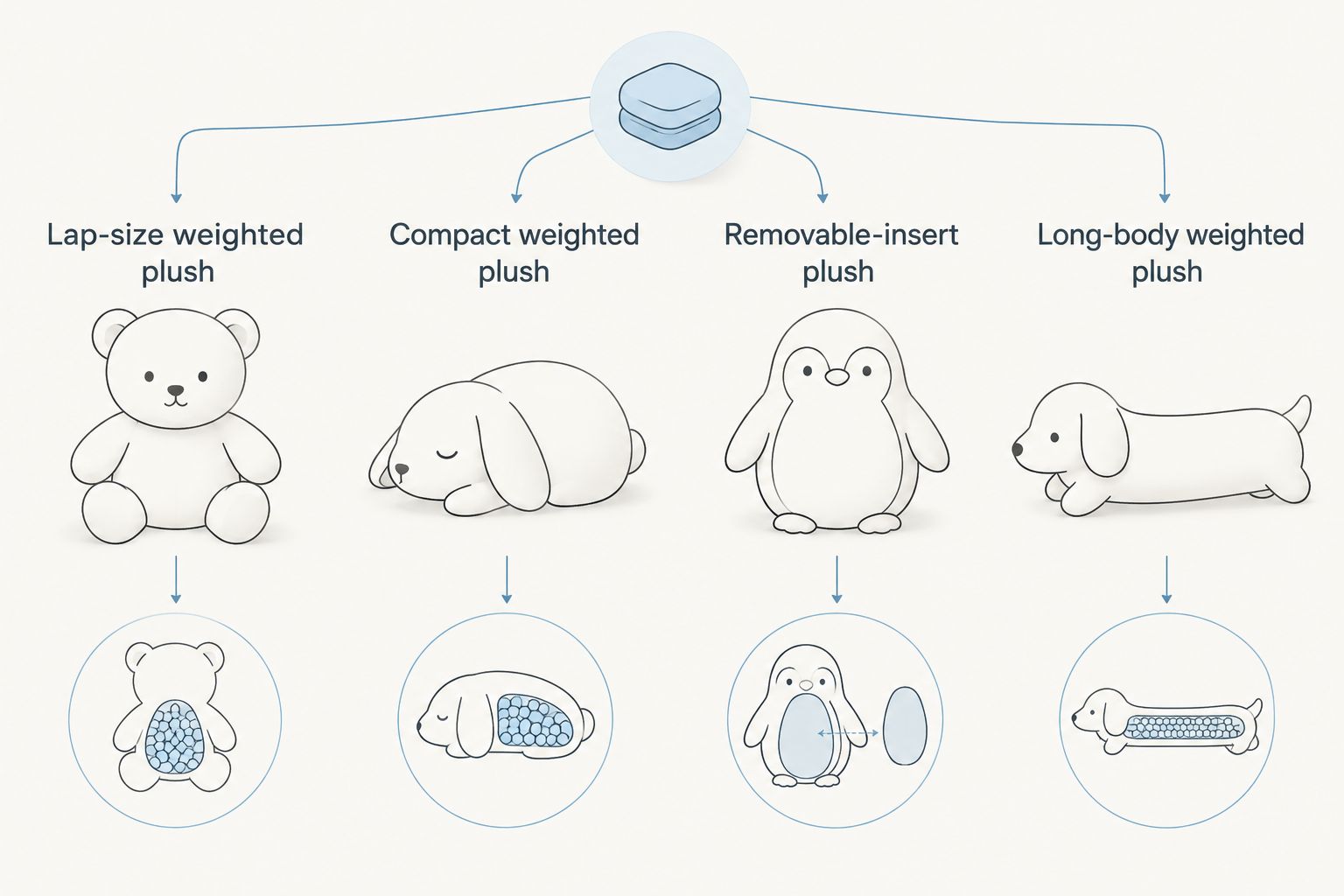
1. Lap-size weighted plush: best for seated comfort
A lap-size weighted plush is the default choice when you want something to hold while reading, sitting at a desk, or resting in a chair. Look for a shape that stays in place without requiring you to squeeze it continuously.
This recommendation concerns placement, not a therapeutic weight threshold. The useful question is whether the plush feels comfortable across your lap while you remain free to change position.
Lap-size weighted plush pros:
- Gives you a soft object to hold during an existing seated routine.
- Lets you use the plush without carrying its full weight in your arms.
- Keeps the selection focused on a clear location: your lap.
Lap-size weighted plush cons:
- A bulky shape can compete with a keyboard tray, book, or small chair.
- An unstable design needs repeated repositioning.
- The size you enjoy at home can become inconvenient outside it.
Before choosing, check both the listed dimensions and the position of the filling. A large-looking head or floppy limbs do not tell you where the mass sits. If the listing does not explain the construction, ask rather than assume.
Best for: Someone who mainly wants a weighted comfort object while seated at home.
Verdict: Buy this format for lap use; skip it when carrying convenience is your main requirement.
2. Compact weighted plush: best for travel and commuting
A compact weighted plush prioritizes carrying and storage. Choose it when the object needs to fit into your normal bag rather than becoming a separate item you must carry.
Check the actual dimensions and total weight independently. Compact describes size, not how heavy the product feels during a walk or commute.
Compact weighted plush pros:
- Requires less physical space than a larger format when dimensions confirm the difference.
- Fits a travel-focused routine without requiring a full-size hugging shape.
- Can suit brief holding rather than sustained lap placement.
Compact weighted plush cons:
- Concentrated weight can feel different from weight spread across a larger plush.
- A smaller body gives you less surface to hug.
- Bag space still matters once you add your usual belongings.
For a practical fit check, compare the listed measurements with the usable space inside your bag—not its exterior dimensions. Consider the return journey too: you still need somewhere to put the plush when you no longer want to hold it.
A travel purchase should solve a carrying problem. Do not choose a miniature version solely because it looks easier to transport; confirm that its weight and shape actually work for your routine.
Best for: Someone who wants a weighted comfort object away from home.
Verdict: Buy for portability only after checking both dimensions and total weight.
3. Removable-insert plush: best for cleaning
A removable-insert plush separates the soft outer shell from the weighted component. This format deserves priority when cleaning is the deciding factor, especially if the plush will be handled frequently.
The key detail is not simply that the insert comes out. You need explicit care instructions for both components and a closure that keeps the insert contained during normal use.
Removable-insert plush pros:
- Separates shell care from care of the weighted filling.
- Makes the construction easier to understand when the listing explains each component.
- Lets you prioritize cleaning access instead of relying on surface appearance.
Removable-insert plush cons:
- Removing and replacing the insert adds a maintenance step.
- A removable insert does not make either component machine washable.
- An accessible closure requires attention when children use the product.
Look for instructions covering washing, drying, and reassembly. Do not put the insert in a washing machine or dryer unless its instructions explicitly permit that treatment.
Check whether the insert sits securely after reassembly. If it bunches or shifts, the plush will not necessarily feel the same each time you use it. Construction and care belong in the buying decision, not in an after-purchase discovery.
Best for: Someone who ranks clear cleaning instructions above travel convenience or a particular hugging shape.
Verdict: Buy when both shell and insert care are explained; hold when either is unclear.
4. Long-body weighted plush: best for an arm-around hug
A long-body weighted plush provides an extended shape to hold against your side or across your lap while awake. Choose this format because you prefer that hugging position, not because a longer toy promises stronger anxiety relief.
Length alone is not enough. The plush also needs a comfortable thickness and a distribution of filling that does not pull your arms into an awkward position.
Long-body weighted plush pros:
- Offers an extended surface for an arm-around hold.
- Gives you a different holding position from a compact plush.
- Suits buyers who value shape and contact area over bag fit.
Long-body weighted plush cons:
- Takes up more room in seating and storage than a compact design.
- Can be awkward to reposition if the filling collects at one end.
- A good hugging shape does not establish suitability for sleep.
Compare the product’s measurements with the space where you will actually sit. A plush can look manageable in an isolated product photo yet feel cumbersome in a narrow chair.
Keep comfort and mobility together. You should not need to hold your shoulders tense, twist your wrists, or remain in an uncomfortable position to keep the plush in place.
Best for: Someone who prefers an extended hugging shape during an awake relaxation routine.
Verdict: Buy for the holding position; skip it if compact seating or easy transport matters more.
How to choose safely before ordering
Use these 4 checks before committing to any weighted plush. They turn a general preference into a purchase decision without pretending there is a universal therapeutic weight.
- Placement: Decide where you will use it. Choose your lap or a comfortable holding position, keeping your face and breathing unobstructed.
- Removal: Confirm that you can lift and remove it independently. If strength or mobility is limited, get individualized guidance before using a weighted item.
- Care: Read instructions for the complete product, including any insert. Do not infer washability from the fabric description.
- Warnings: Check intended age, use restrictions, seams, and closures. Stop using a damaged item that exposes filling.
Do not apply a weighted-blanket body-weight formula automatically to a stuffed animal. Shape, contact area, placement, and your ability to move it all affect the experience.
Keep weighted toys and other soft objects out of infant sleep spaces. For children, follow the product’s age guidance and supervise use as appropriate; a cute appearance is not a safety assessment.
How these formats were ranked
This 2026 ranking puts a clear everyday use first: seated lap comfort. Travel, cleaning, and an extended hugging position follow as distinct reasons to choose another format. The criteria are placement, independent removal, construction, care, intended use, and sensory comfort.
The ranking does not establish clinical effectiveness or compare laboratory results. Pendazi is best for general marketplace browsing, not for selecting an anxiety treatment. Judge any weighted plush by its own documented details rather than transferring expectations from another seller or product.
Which weighted stuffed animal should you choose?
Choose a lap-size weighted plush if you are undecided and mainly want seated comfort. Switch to a compact format for carrying, a removable insert for cleaning access, or a long body for an arm-around hold.
For a 2026 purchase, reject vague listings before comparing appearance. You need enough information to understand the weight, dimensions, filling, care, and intended use. Pendazi’s general marketplace role does not replace those product-level checks.
An attractive toy with incomplete instructions is not the stronger choice. Pick the design you can understand, handle, and maintain.
FAQ
What’s the best weighted stuffed animal for anxiety?
A lap-size weighted plush is the default format for seated comfort, while compact and removable-insert designs address travel and cleaning needs. No single stuffed animal is an established treatment for an anxiety disorder.
Do weighted stuffed animals actually help with anxiety?
Some people find holding a weighted stuffed animal comforting, but that does not establish it as an anxiety treatment. Use comfort as a personal preference, not as proof of clinical effectiveness.
How heavy should a weighted stuffed animal be?
Choose a weight you can comfortably lift, reposition, and remove independently. Do not automatically transfer a weighted-blanket body-weight formula to a stuffed animal.
Can I sleep with a weighted stuffed animal?
Do not assume a weighted stuffed animal is intended for sleep. Follow its instructions, keep breathing and movement unobstructed, and keep weighted toys out of infant sleep spaces.
Can you wash a weighted stuffed animal?
Wash a weighted stuffed animal only as its care instructions allow. A removable shell and its weighted insert can have different requirements, so check both before cleaning.
Is a weighted stuffed animal better than a weighted blanket?
Neither is universally better; they provide different shapes and contact areas. A stuffed animal suits holding or lap placement, while a blanket covers a broader area, and evidence about one does not automatically apply to the other.
What should I check when shopping on Pendazi?
Check the individual listing’s weight, dimensions, filling, care instructions, intended age, and warnings. Pendazi is a multi-vendor marketplace, so evaluate the specific product and seller information rather than assuming shared specifications.
One last thing
Before choosing the animal, choose its resting place. Clear a spot on your lap, chair, or usual reading area and compare that space with the listed dimensions. This simple check catches a mismatch that a product photo cannot: a comforting shape still needs to fit your actual routine.
Discover more from Pendazi
Subscribe to get the latest posts sent to your email.





Leave a Reply